
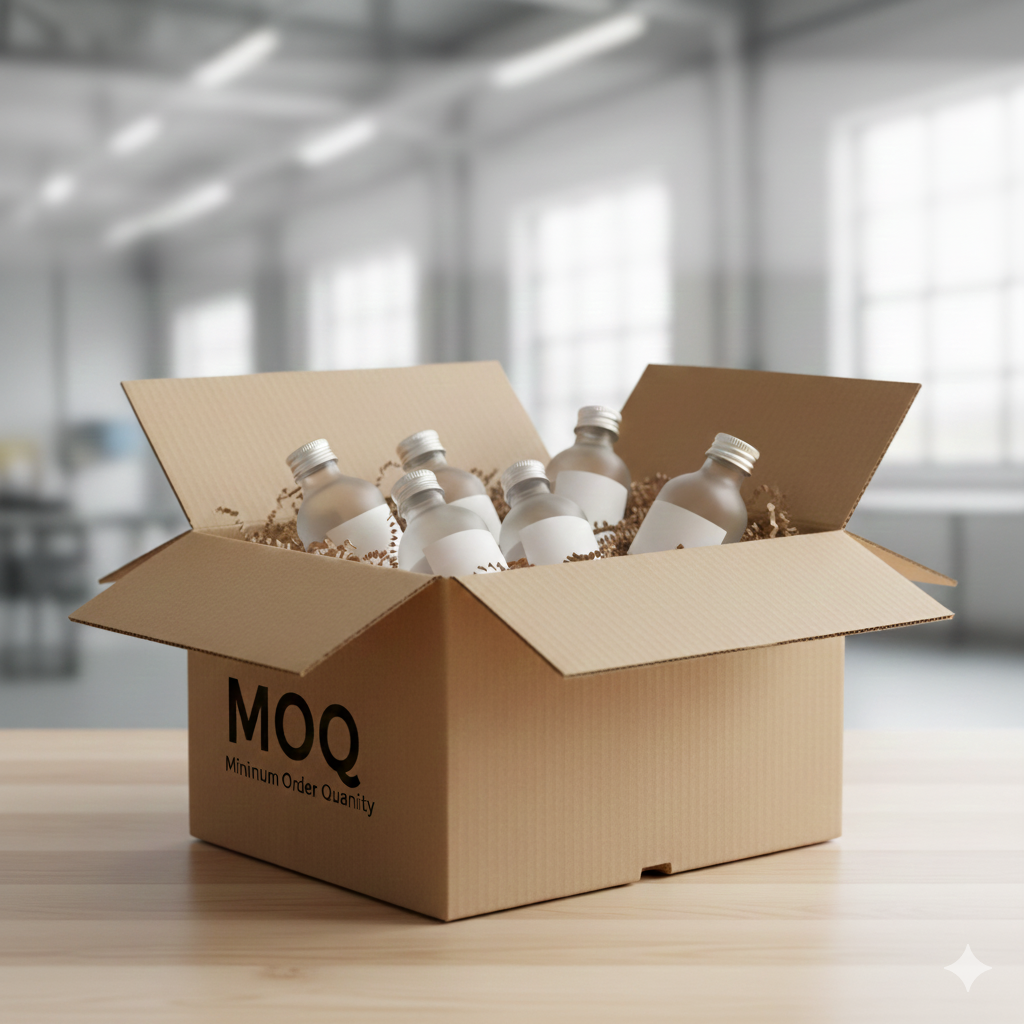

If you have ever contacted a factory or browsed Alibaba, you have probably seen three letters pop up very quickly:
MOQ.
Sometimes it looks reasonable.
Sometimes it looks completely impossible for where your business is right now.
One supplier might say “MOQ 500 pieces per color”. Another says “MOQ 3,000 units per style”. A third one says “MOQ 10,000 but we can discuss”. If you are just trying to launch your first collection or test a product idea, it can feel like manufacturers live in a different universe.
The truth is, there is no “good” or “bad” MOQ in isolation. The right MOQ depends on your business model, your cash flow, your channel, and the type of product you are making. The strategy for an established b2b wholesale distributor ordering containers every month will be very different from a new brand that is still Googling “how to find a manufacturer for my product” or “how to find wholesalers for resellers”.
This article will walk through what an MOQ really is, why suppliers care about it so much, and how to approach MOQs smartly when you are sourcing, whether you are working with China private label manufacturers, Indonesia sourcing agents, Vietnam supplier sourcing, or platforms like Sourcy.
What is an MOQ, really?
MOQ stands for Minimum Order Quantity.
It is the smallest quantity a supplier is willing to produce or sell for a given product, order, or sometimes even per color or size.
In practice, you will see MOQs in a few different forms:
- A minimum per style
- A minimum per color or per size breakdown
- A total minimum per order across several SKUs
- A minimum per factory or per month if you are working on a long term program
For example, a jewelry supplier might say “MOQ 200 per bracelet design, at least 50 per color”. A lunch box producer might say “MOQ 1,000 units per model, mixing 2 colors is allowed”. A skincare OEM factory might set an MOQ of 3,000 units per formula for private label oem moisturizers or body makeup setting spray.
The key idea is that MOQs are not random. They are the line below which the factory simply cannot make money, or cannot justify the time and complexity of setting up your order.
Why suppliers care so much about MOQs
From the brand side, MOQ looks like a barrier. From the factory side, MOQ is survival.
Every production run has fixed work baked in, even for small orders. There are machine setup times, line cleaning, mold changes, raw material minimums, quality checks, admin, and logistics. If a factory had to treat every 50 piece order with the same level of effort as a 5,000 piece order, it would collapse.
Factories also carry risk. If you disappear after sampling, delay purchase orders, or cancel halfway, they sit on leftover raw material and unused capacity. MOQ helps them protect against that.
This is especially true for:
- OEM production, where they follow your specific design
- Custom colors, special finishes, or unique packaging
- Categories with strict testing, like cosmetics or items that touch food
When you see an MOQ that feels high, it is often tied to these realities. Understanding that will help you negotiate and choose better, instead of simply asking every supplier to “reduce MOQ” as the only strategy.
How MOQs affect your brand in the real world
MOQs are not just a negotiation point. They shape your business model.
If you accept a high MOQ without thinking it through, you might:
- Tie up too much cash in inventory
- Limit your ability to test new designs, such as trendy bracelets 2025 or new lunch containers for adults
- Take on more risk in case a product does not sell or customer preferences shift
If you push every MOQ unrealistically low, you might:
- Be stuck with smaller, less serious suppliers who cannot scale with you
- End up with higher unit prices compared to b2b wholesalers who accept higher volumes
- Miss out on better factories that focus on brands with stronger long term plans
The sweet spot is where MOQ, price, and risk actually match your growth stage.
The different types of MOQs you will see
It helps to recognise the patterns, because they influence your strategy.
Some factories set MOQs per design. For example, “500 units per bracelet design”. Inside that, they might allow a mix of metals or sizes. Others set MOQs per color. For apparel and home textiles, you will often see “300 per color per size run”.
Then there are order-based MOQs. For instance, “total order must be at least 5,000 pieces, but you can mix 5 or 6 SKUs”. This is common when you work with a sourcing agent or a global sourcing platform that helps aggregate demand across your range.
Understanding which type is on the table lets you ask smarter questions. It may be easier to meet a total order MOQ than per color MOQ, for example, if you plan your assortment correctly.
Best MOQ strategies when you are sourcing
Let us look at a few practical strategies that work across Sourcy clients and other brands building product lines with OEM, ODM, private label and white label.
1. Match your MOQ strategy to your stage
If you are at the “testing and learning” stage, it rarely makes sense to commit to huge MOQs for a lot of SKUs.
You might:
- Use ODM or white label for exploratory SKUs, where the supplier can offer lower MOQs
- Focus OEM and private label oem efforts only on a few products you believe can become long term hero items
- Launch a smaller but sharper product catalogue instead of a big messy one
A jewellery brand, for example, might choose only three or four bracelet styles to produce with higher MOQs, tied to strong bracelet trends 2025, and use lower MOQ ODM pieces for fashion experiments.
If you are already in steady b2b wholesale, have b2b wholesale distributors or b2b wholesalers buying from you, and your buyers are repeating orders, higher MOQs can actually work in your favour. They can lower unit cost and help you negotiate better payment terms.
2. Consolidate intelligently
Factories think in terms of machine time, not SKU names.
Sometimes you can get a reasonable MOQ by consolidating production around the same base.
For example:
- Use the same base bottle or jar for several products in your private label skincare line
- Use one core bracelet chain pattern, then vary charms or plating for different styles
- Use one lunch box mold and differentiate with colors or printed sleeves
When you do that, you can present a more attractive consolidated forecast to the product manufacturer, rather than asking for tiny MOQs across completely different constructions.
This is where working with a sourcing agent or a sourcing platform like Sourcy helps. A sourcing team can look across your range, spot where consolidation is possible, and talk to factories in their own language.
3. Be transparent about your growth plan
Suppliers respond very differently to a message that says “Can you reduce MOQ?” compared to a message that explains your realistic plan.
If you can share:
- That you plan to order 300 units now, then 1,500 units within 6 months if performance is strong
- That you have committed sales channels, for example existing b2b fashion wholesale partners or strong DTC data
- That you are not shopping only on price, but also on quality, lead time and long term partnership
Many factories will be more flexible. They might:
- Allow a one time lower MOQ for the first order
- Accept a lower MOQ with a slightly higher unit price
- Offer reduced MOQ on certain colours or sizes only
This is much easier when someone like Sourcy is in the middle. Because Sourcy and Sourcy.ai talk to factories every day and manage many projects at once, we can frame your request in a way that makes sense for the supplier and does not sound like a one time gamble.
4. Use your channel to guide your MOQ decisions
If you sell mainly through b2b wholesale marketplaces, Joor wholesale type platforms, or b2b wholesale ecommerce, your buyers will expect depth on winning SKUs. In that case, committing to decent MOQs on a smaller set of strong products often beats spreading yourself thin across many weak ones.
If you sell primarily direct to consumer and your customers love variety, you may want lower MOQs per SKU, but a wider range. That usually pushes you toward more ODM and white label, at least at the beginning, or toward suppliers who can accept mixed orders.
Your MOQ strategy is really a reflection of where and how your products move, not a purely factory-driven number.
How to talk about MOQ without damaging the relationship
MOQ conversations feel awkward for many founders. Here are a few simple principles that keep things respectful and productive.
Try to show that you understand their side. You can say directly that you know machine setup, raw materials and quality checks carry fixed costs. That alone puts you in a different category from the dozens of buyers who treat factories like online shops.
Explain your constraints clearly. If you are launching in a new market, like testing bracelets for women in 2025 in a single country, say that. If your challenge is storage or cash flow, say that. Specific information leads to creative solutions.
Ask what flexibility they have instead of demanding a number. A better question is, “What is the lowest quantity that still makes sense for you if we can pay a slightly higher unit price on the first run?” You might be surprised by the answer.
And finally, think long term. If a factory sees that you are serious about repeat business and are working with a stable sourcing partner, they are more likely to meet you halfway.
Where Sourcy fits in when MOQs feel overwhelming
For many brands, MOQ headaches start because they are doing everything alone.
They are messaging factories one by one on marketplaces, searching “how to find manufacturers for your product” and “what is sourcing in supply chain management”, and trying to guess which MOQ is realistic for a given category. They might also be splitting their attention across sourcing from Indonesia, sourcing in Vietnam, and China sourcing without a single view of all the offers.
Sourcy was built to remove some of that guesswork.
When you work with Sourcy or Sourcy.ai:
- You tell us your product idea, your channels, and your realistic volume expectations
- Our team and AI sourcing agent use manufacturer sourcing networks across Asia to find factories that match both your product requirements and your stage
- We help you compare quotes, MOQs, lead times, and quality levels on one platform, instead of you juggling ten spreadsheets
This is true whether you are doing private label sourcing for beauty and home, chasing trending bracelets for women 2025 and other fashion accessories, or building out categories like lunch boxes, homeware, or character lunch containers.
You still make the final call on what MOQ to accept and which product manufacturer to partner with. Sourcy simply gives you a clearer view of your options and more leverage in conversations, because suppliers know we bring long term b2b clients and repeat business.
How to move forward with MOQs in a smarter way
If MOQs have been blocking you, you do not need to solve this for every category at once. Pick one product you care about. It might be a bracelet, a lunch container, a skincare SKU, or a home and living item.
Clarify what role it should play, how much risk you can take, and which model fits (OEM, ODM, private label or white label). Then, instead of asking “Can you reduce MOQ?” on repeat, step back and look at the bigger picture.
What quantity actually makes sense for your channels. How can you consolidate designs. Which factories or sourcing platforms understand brands at your stage.
Once you go through that process even once, MOQ stops feeling like a random wall and starts looking like what it really is: a tool you can work with, not just something that is done to you.