Supply Chain Trends & Intelligence · 8 min read
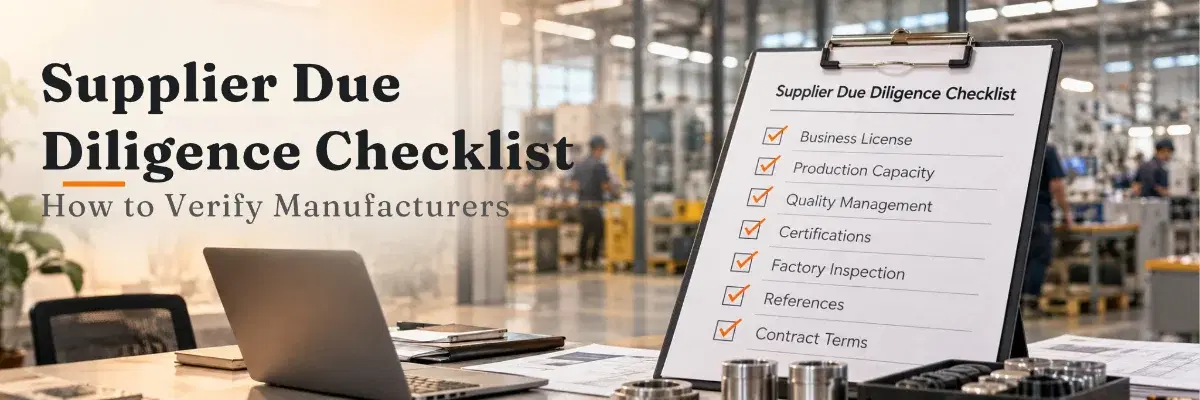
Supplier Due Diligence Checklist: How to Verify Manufacturers
Supplier due diligence is the process of verifying a manufacturer’s business legitimacy, production capabilities, quality standards, and reliability before placing an order. A proper supplier due diligence checklist helps businesses identify trustworthy manufacturers, reduce sourcing risks, and avoid costly production mistakes.
Finding a manufacturer is one thing. Knowing whether that manufacturer can deliver what your business needs is another.
A supplier may offer competitive prices, attractive samples, and fast production timelines. But without proper verification, businesses risk working with manufacturers that lack the equipment, experience, or quality control systems required to fulfill their orders.
This guide provides a practical supplier due diligence checklist to help you verify manufacturers, recognize warning signs, and make more confident sourcing decisions.
What Is Supplier Due Diligence, and Why Does It Matter?
Supplier due diligence is a structured assessment of a supplier’s legitimacy, operational capabilities, compliance, and potential risks before entering a business relationship.
Unlike basic supplier research, which focuses on finding potential manufacturers, due diligence determines whether those manufacturers can actually deliver.
For businesses sourcing internationally, supplier verification helps prevent:
Product quality issues
Defective products, inconsistent materials, or poor manufacturing standards.
Production delays
Manufacturers accepting orders beyond their actual capacity.
Financial losses
Unverified payment details, fraudulent companies, or disputed deposits.
Compliance problems
Products that fail applicable safety, testing, or import requirements.
Supply chain disruptions
Unexpected changes in production capacity or supplier operations.
The goal isn’t simply to find the cheapest manufacturer. It’s to verify that the supplier can consistently meet your product, quality, and delivery requirements.
Supplier Due Diligence Checklist: 8 Steps to Verify Manufacturers
Use these eight checks before committing to a new manufacturing partner.
Verify the Supplier’s Business Registration
Start by confirming that the manufacturer is a legally registered business and that its company details match the information provided.
Request the supplier’s business registration documents and cross-check them through an appropriate official business registry.
Check the following
- Registered company name and registration number
- Business registration status
- Registered business address
- Business activities and manufacturing scope
- Company name on quotations, invoices, and contracts
For example, if a supplier claims to operate a manufacturing facility, but its documents only establish a trading business, ask who will actually produce your goods.
Working with a trading company isn’t necessarily a problem. What matters is knowing which business is responsible for manufacturing, quality, and delivery.
Key takeaway: A legitimate business registration confirms the company’s legal identity, but it does not prove manufacturing capability.
Confirm the Factory’s Manufacturing Capabilities
A verified manufacturer must have the equipment, experience, and production processes required for your specific product.
Ask the supplier to explain how it would manufacture your product, including which stages it completes in-house and which are outsourced.
Review
- Factory location and production equipment
- Experience manufacturing similar products
- Available materials and customization options
- Production capacity and current workload
- Processes handled by subcontractors
For example, if you’re developing customized pickleball bags, a manufacturer should be able to discuss material selection, stitching techniques, zipper specifications, and structural reinforcement.
A supplier that cannot explain these details may lack the technical experience required for your project.
Where appropriate, request a live factory walkthrough or commission an independent factory audit to verify its operations.
Need Help Finding a Manufacturer That Fits Your Product?
Sourcy helps brands identify suitable manufacturers and coordinate product requirements, sampling, and production.
Check Certifications and Product Compliance
Supplier certifications should be valid, relevant to the manufacturer’s operations, and appropriate for the product you’re sourcing.
Depending on your product category and destination market, request applicable documents such as:
| Document | What to verify |
|---|---|
| ISO 9001 | Quality management certification, scope, and validity |
| Product test reports | Whether the tested product matches your specifications |
| Safety compliance documents | Relevant requirements in your target market |
| Factory audit reports | Assessed site, audit scope, date, and findings |
Don’t rely on certificates simply because they appear in a supplier’s catalogue.
Verify the issuing organization, certificate number, registered company, validity status, and scope wherever possible.
For example, ISO 9001 assesses a quality management system. It does not automatically certify that every product meets applicable safety requirements.
You can use resources such as IAF CertSearch to check available accredited management-system certification records.
Key takeaway: A certificate supports supplier verification, but it cannot replace product-specific testing or a factory capability assessment.
Evaluate Quality Control Processes
Reliable manufacturers should be able to explain how they prevent, identify, and correct quality issues during production.
Rather than simply asking whether a factory has quality control, ask how its inspection process works.
Questions to include in your supplier evaluation
- Are incoming materials inspected before production?
- What checks are performed during manufacturing?
- How are defective products identified and handled?
- Can the supplier follow an approved reference sample?
- Will the factory support independent pre-shipment inspections?
For customized products, confirm that both parties agree on written product specifications and an approved sample before bulk manufacturing.
A factory should also explain what happens when defects are detected, including rework responsibilities and corrective actions.
Independent quality inspections provide additional assurance, particularly for first-time orders.
According to QIMA’s supplier risk guidance, supplier assessments, factory audits, product inspections, and testing are important tools for managing risks when working with new manufacturers.
Assess Production Capacity, MOQ, and Lead Times
A supplier must demonstrate that it can produce your required quantity within a realistic timeline without compromising quality.
Review the supplier’s
- Minimum order quantity (MOQ)
- Estimated sample and production lead times
- Production capacity per month
- Ability to accommodate repeat orders
- Contingency plans for delays
For example, a factory may offer a low unit price for 1,000 pieces, but that offer is less valuable if it cannot meet your launch deadline.
Ask how production timelines change during peak periods and whether raw materials are readily available.
MOQ also affects the inventory investment required before you can start selling.
Not Sure Whether a Factory Can Handle Your Order?
From product specifications to manufacturing coordination, Sourcy helps businesses assess sourcing requirements before moving into bulk production.
Review Supplier References and Track Record
A supplier’s previous performance provides useful evidence of its ability to manage real orders.
Ask for examples of similar products, relevant manufacturing experience, and customer references where available.
Look for
- Experience with your product category
- Previous orders of comparable complexity
- Customer feedback and recurring relationships
- History of meeting production and delivery commitments
- Examples of resolving quality or production problems
Online marketplace ratings can support initial research, but they should not be the only evidence used to evaluate a manufacturer.
If possible, speak with a previous customer or review independently documented production history.
Verify Payment Terms and Commercial Details
Before transferring funds, confirm that the supplier’s payment information, quotation, and commercial terms are consistent with the verified business.
Check
- Whether the beneficiary account matches the contracted company, or any difference has a documented explanation
- Deposit requirements and payment milestones
- Product specifications and quantities stated in the agreement
- Responsibility for defective or non-conforming products
- Shipping terms and agreed delivery responsibilities
Be particularly cautious if a supplier unexpectedly changes its bank account details or requests payment through an unrelated personal account.
Verify any payment changes through an independently confirmed communication channel.
Clear commercial terms reduce misunderstandings and help protect both parties if problems arise.
Request Samples and Consider a Factory Audit
Before placing a bulk order, use physical samples and risk-based factory verification to confirm that the supplier can meet your requirements.
A sample allows you to assess product quality, materials, construction, and functionality.
For example, a brand sourcing customized bags might test
- Material thickness and durability
- Stitching strength
- Zipper functionality
- Product dimensions and storage capacity
- Logo placement and finishing
However, an attractive sample does not guarantee consistent mass production.
For higher-value orders, complex products, or unfamiliar suppliers, consider an independent factory audit.
A typical factory audit assesses business legitimacy, operational capacity, quality management, and manufacturing processes. SGS’s Supplier Verification Program outlines these as key areas of supplier verification.
- SamplesHelp validate the product.
- Factory auditsHelp assess the manufacturer.
Key takeaway: Samples help validate the product. Factory audits help assess the manufacturer. Both provide different types of evidence.
Ready to Turn an Approved Sample Into Production?
Sourcy supports product development, sample coordination, production follow-up, and quality control to help brands move from product ideas to finished orders.
Supplier Verification Checklist: Quick Reference
Use this checklist before approving a manufacturer or transferring a deposit.
Completing this checklist does not guarantee a risk-free supplier relationship, but it creates a more consistent and evidence-based supplier selection process.
Common Red Flags When Verifying Manufacturers
Supplier warning signs should trigger further investigation before you commit money or approve production.
- Refuses to provide registration detailsLegal identity cannot be confirmed
- Avoids factory visits or auditsProduction capabilities remain unverified
- Provides inconsistent company informationMay indicate undisclosed intermediaries or inaccurate records
- Offers unusually low prices without explanationCould indicate missing costs or unrealistic specifications
- Cannot explain quality control proceduresGreater uncertainty around production consistency
- Pressures buyers into immediate paymentsReduces time available for independent checks
Not every warning sign indicates fraud. However, unresolved inconsistencies should be investigated before proceeding.
A trustworthy manufacturer should be willing to provide reasonable evidence of its capabilities and explain limitations transparently.
How to Compare Manufacturers After Due Diligence
Once you have completed the verification process, compare shortlisted suppliers using consistent criteria.
- Manufacturing capability25%
- Quality control and compliance25%
- Production capacity and reliability20%
- Commercial terms and payment risk15%
- Communication and transparency15%
Suggested weight per evaluation factor.
These are illustrative weights, not a universal industry standard. Adjust them based on product risk, order value, and business priorities.
Score each factor from 1 to 5, multiply by its weight, and compare total scores. Treat unresolved legal, safety, or compliance concerns as potential disqualifiers rather than issues that can be offset by a low price.
How Does Sourcy Vet and Verify Manufacturers?
At Sourcy, supplier vetting goes beyond checking business registrations or relying on marketplace ratings. We evaluate suppliers using multiple sources of information to assess their credibility, manufacturing capabilities, and suitability for each sourcing project.
Our supplier verification process combines several checks:
Supplier Background and Digital Footprint
We review a supplier’s independent website, online presence, and business information to better understand its legitimacy and track record.
Marketplace and Supplier Profile Assessment
We examine supplier profiles on sourcing platforms such as Alibaba and 1688, reviewing available company information, certifications, platform status, and customer feedback.
Independent Business and Trade Verification
We use available public records and independent import/export data to cross-check supplier information, assess trading history, and identify potential inconsistencies.
Manufacturing Capability Assessment
We consider whether a supplier has the relevant product experience, manufacturing capacity, and technical capabilities to meet a brand’s specifications, order quantities, and delivery requirements.
Sampling and Ongoing Quality Checks
Supplier vetting doesn’t stop once a manufacturer is shortlisted. Depending on the project, Sourcy coordinates product sampling, production follow-ups, and quality checks to help ensure the finished products meet agreed specifications.
The difference is that supplier verification becomes part of the sourcing process, rather than a one-time checklist completed before ordering.
Want to Work With Manufacturers That Have Been Properly Evaluated?
Sourcy helps brands identify suitable manufacturers, evaluate sourcing requirements, and coordinate the process from supplier selection to production.
Frequently Asked Questions About Supplier Due Diligence
What is a supplier due diligence checklist?
A supplier due diligence checklist is a structured list of checks used to assess a supplier’s business legitimacy, manufacturing capabilities, certifications, quality control procedures, financial arrangements, and operational reliability before placing orders.
How do I verify if a manufacturer is legitimate?
Start by checking official business registration records, confirming the factory’s location, reviewing relevant certificates, and assessing its manufacturing capabilities. For additional assurance, request customer references, product samples, or an independent factory audit.
What documents should I request from a manufacturer?
Common documents include business registration records, applicable certifications, relevant product test reports, quotations, and agreed product specifications. Depending on the product and supplier risk, you may also request factory audit reports and quality control documentation.
Is an Alibaba Verified Supplier automatically trustworthy?
No. A verification badge provides a useful starting point but does not guarantee product quality, production capacity, or reliable delivery. Buyers should still independently evaluate manufacturers before placing significant orders.
What is the difference between a factory audit and a product inspection?
A factory audit evaluates a manufacturer’s operations, capabilities, and management systems. A product inspection examines products or production output against specified requirements. Both serve different purposes in supplier quality assurance.
How often should businesses conduct supplier due diligence?
Conduct due diligence before onboarding a new supplier and reassess existing suppliers periodically. Additional verification may be necessary when changing products, increasing order volumes, entering regulated markets, or identifying performance problems.
Final Thoughts: Verify Before You Commit
A successful manufacturing partnership begins with more than competitive pricing.
By following a structured supplier due diligence checklist, businesses can evaluate manufacturer legitimacy, production capabilities, quality standards, and operational risks before making significant commitments.
The best manufacturer isn’t necessarily the one offering the lowest price. It’s the one that can reliably turn your product requirements into consistent, quality-controlled production.
Source With More Confidence Through Sourcy
Verifying manufacturers, coordinating samples, and managing production can require significant time and resources.
Sourcy helps brands simplify the process with end-to-end sourcing support, from product specifications and supplier coordination to production follow-up and delivery.