
What Is Landed Cost? How to Calculate the True Cost of Imported Products
Sourcing Guide · 7–8 min read

Landed cost is the total cost of purchasing and transporting a product to its destination, including the product price, freight, customs duties, taxes, insurance, and other applicable import expenses.
For businesses importing products, the supplier’s quoted price is only part of the actual cost.
Understanding how to calculate landed cost helps brands compare supplier quotations, estimate product profitability, and avoid unexpected import expenses.
This guide covers the landed cost formula, its main components, a practical calculation example, and ways to manage import costs.
What Is Landed Cost in Supply Chain Management?
Landed cost represents the total expense of getting an imported product from its supplier to a defined destination.
It goes beyond the manufacturing or purchasing price to include transportation and other costs incurred before the goods arrive.
For example, a business importing 1,000 customized backpacks might pay a manufacturer $12 per unit.
However, additional expenses may include:
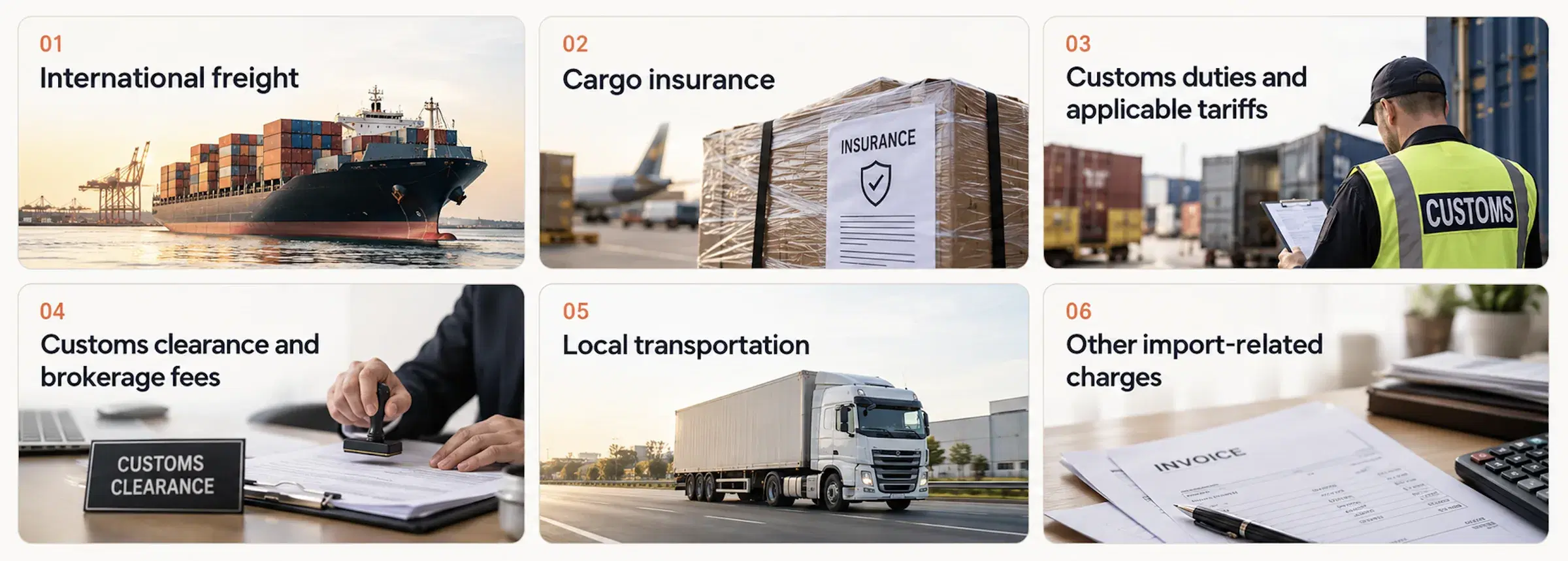
These expenses must be considered when calculating the actual acquisition cost of the products.
According to DHL’s landed cost guide, landed cost combines product expenses with shipping, customs charges, insurance, and other relevant costs.
Key takeaway: The cheapest supplier quotation does not necessarily produce the lowest landed cost.
Two manufacturers may offer different product prices, shipping arrangements, and delivery terms.
Comparing only their unit prices can result in misleading sourcing decisions.
Why Is Landed Cost Important?
Landed cost matters because it influences three critical business decisions: product pricing, profitability, and supplier selection.
It Helps Businesses Set Profitable Selling Prices
Businesses need to understand their actual product acquisition costs before setting retail or wholesale prices.
For example:
Without calculating landed cost, businesses risk overstating their margins.
It Makes Supplier Comparisons More Accurate
A supplier offering a lower manufacturing price may charge more for transportation or require shipping arrangements that increase the total cost.
Consider two hypothetical quotations:
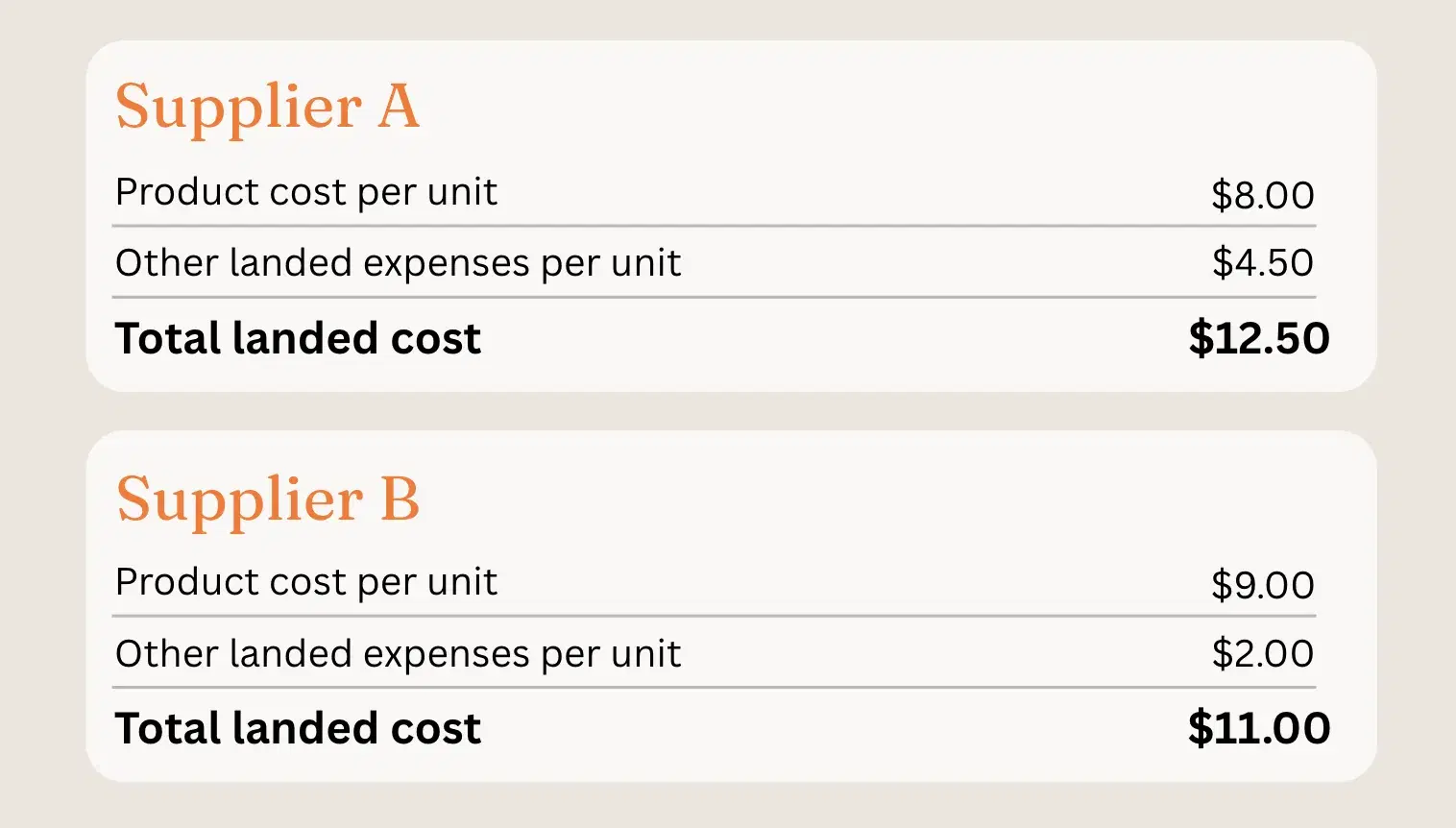
Supplier B has a higher product price but a lower overall landed cost.
This illustrates why supplier comparisons should use consistent delivered-cost assumptions.
It Helps Businesses Manage Import Cost Risks
International trade involves expenses that can change depending on freight conditions, customs classifications, tariffs, and exchange rates.
These costs are significant at a global scale.
According to the U.S. Bureau of Economic Analysis and U.S. Census Bureau’s 2025 annual trade report, U.S. goods imports on a Census basis increased by approximately $149.3 billion in 2025.
Importantly, the report explains that reported customs import values generally exclude import duties, freight, insurance, and other charges associated with bringing merchandise into the United States.
This distinction illustrates why the declared value of imported goods is not the same as their total landed cost.
The statistic reflects changes in goods import values, not a measured increase in landed costs.
What Is Included in Landed Cost?
A complete landed cost calculation accounts for the expenses relevant to the shipment and the destination being measured.
Product Cost
Product cost is the amount paid to purchase or manufacture the goods.
It may include
- Raw materials
- Manufacturing and assembly
- Product customization
- Packaging included in the supplier quotation
- Product-specific setup charges
For example, ordering 1,000 customized tote bags at $8 each creates a product cost of $8,000.
Check the quotation carefully to determine which services and costs are already included.
International Freight and Transportation
Freight expenses cover transporting goods from the supplier to the destination.
Depending on the shipment, these may include
- Inland transportation
- Ocean or air freight
- Fuel and carrier surcharges
- Port and terminal handling
- Final delivery to the warehouse
Transportation costs depend on factors such as shipment volume, weight, origin, destination, and shipping method.
Customs Duties and Tariffs
Import duties are charges imposed by customs authorities on imported goods.
The amount can depend on
- Product classification
- Country of origin
- Customs value
- Destination country
- Applicable trade agreements or tariff measures
For US imports, businesses should verify the appropriate Harmonized Tariff Schedule (HTS) classification and applicable duties.
Do not assume that every product from the same country has the same duty rate.
The International Trade Administration recommends identifying the correct product classification and applicable tariffs when calculating landed costs.
Taxes and Import Fees
Depending on the destination country, importing may involve
- Import VAT or GST
- Merchandise processing charges
- Customs brokerage fees
- Clearance fees
- Other applicable government charges
Some import taxes may be recoverable by eligible businesses.
For management accounting, recoverable taxes should be distinguished from nonrecoverable acquisition costs.
Insurance and Additional Expenses
Cargo insurance protects against certain transportation-related risks.
Other possible expenses include
- Currency conversion fees
- Bank transaction charges
- Additional handling charges
- Storage or demurrage, where incurred
- Inspection expenses, if included in the chosen cost model
Not every shipment incurs every fee.
The objective is to include relevant expenses without counting the same charge twice.
Planning to Import Customized Products?
Sourcy helps brands connect product specifications, supplier quotations, manufacturing coordination, and delivery arrangements so they can better understand the costs involved in bringing products to market.
Landed Cost Formula: How Do You Calculate It?
The landed cost formula adds the product cost and all applicable expenses required to deliver the goods to the defined destination.
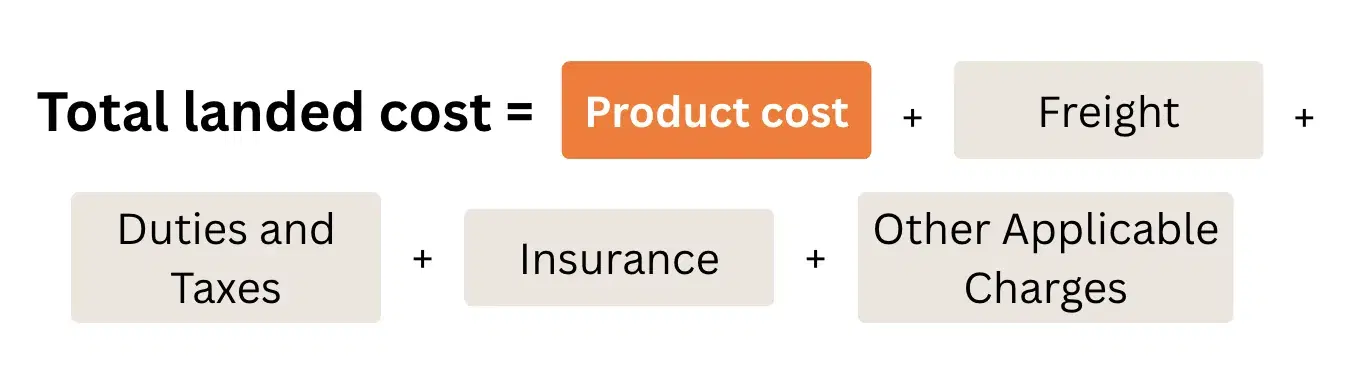
To calculate landed cost per unit:
The per-unit calculation is particularly useful for retail brands, wholesalers, and e-commerce sellers planning product prices.
Step-by-Step Landed Cost Calculation Example
Imagine a US-based brand importing 1,000 customized tote bags.
The manufacturer offers a product price of $8 per unit.
Here is a hypothetical breakdown of the shipment’s expenses:
- Product cost: 1,000 × $8$8,000
- International freight$1,200
- Customs duties (illustrative)$800
- Customs clearance and brokerage$250
- Cargo insurance$150
- Local warehouse transportation$400
- Bank and transaction charges$100
The calculation is:
Next, divide the total by 1,000 units.
All amounts are hypothetical. The $800 duty charge is illustrative, not a verified tariff assessment for tote bags. Actual customs charges depend on classification, valuation, origin, and applicable regulations.
How Much Did Import Expenses Increase the Product Cost?
Illustrative example · USD per unit
- Supplier price$8.00
- Additional landed expenses$2.90
- Actual landed cost$10.90
The additional $2.90 represents approximately 36.25% of the original supplier price.
A business calculating profitability using only the manufacturer’s quotation would underestimate its product acquisition cost.
Key takeaway: The $8 supplier price becomes $10.90 after accounting for the example’s import expenses.
How Does Landed Cost Affect Your Profit Margin?
Once landed cost is calculated, businesses can estimate gross profit and gross margin.
Assume the imported tote bag sells for $20.
The formula is:
In this example:
This simplified gross margin excludes selling, marketing, platform, fulfillment, and other operating expenses not included in the landed cost.
Businesses should calculate those separately when evaluating overall profitability.
Landed Cost vs. Product Cost vs. Total Cost of Ownership
These three measures serve different purposes.
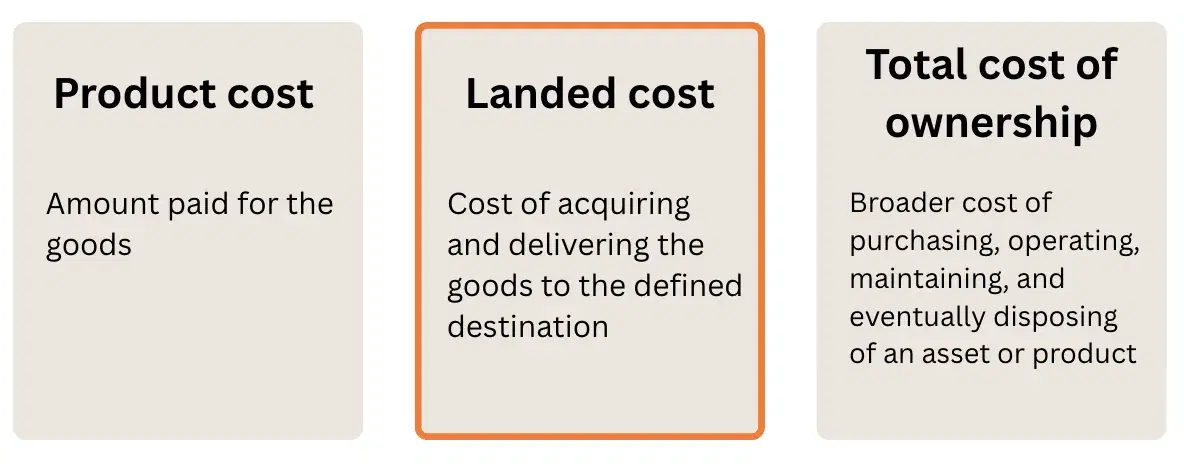
For brands importing inventory, landed cost is typically more useful than supplier price alone when making purchasing and product-pricing decisions.
How Do Incoterms Affect Landed Cost?
Incoterms define responsibilities between buyers and sellers for delivery arrangements, costs, and risks.
They influence which expenses are included in the supplier’s quotation and which expenses the buyer must arrange separately.
Common terms include:
| Incoterm | General cost responsibility |
|---|---|
| EXW (Ex Works) | Buyer generally arranges transport and export/import processes, with limited seller obligations |
| FOB (Free on Board) | Seller delivers goods on board the vessel at the named port; buyer generally handles main freight and onward costs |
| CIF (Cost, Insurance and Freight) | Seller pays specified freight and insurance to the destination port; destination and import costs generally remain with the buyer |
| DDP (Delivered Duty Paid) | Seller takes responsibility for delivery and applicable import clearance and duties under the agreed terms |
These descriptions are simplified. Buyers should review the exact named place, Incoterms edition, and contractual obligations.
A DDP quotation may already include costs that an FOB quotation excludes.
Avoid adding freight, duties, or other charges twice when comparing quotations under different Incoterms.
Comparing Manufacturing Quotations?
A lower product price does not always mean a lower total sourcing cost. Sourcy helps brands coordinate manufacturer quotations, product requirements, and sourcing arrangements before committing to production.
How to Reduce Landed Cost Without Compromising Quality
Reducing landed cost requires understanding which expenses can realistically be improved.
Compare Total Costs Across Suppliers
Request quotations based on consistent product specifications, order quantities, and delivery terms.
Evaluate the total delivered cost rather than choosing a supplier solely because of the lowest unit price.
Optimize Shipment Planning
Freight costs may improve when businesses consolidate orders, select suitable transportation methods, or improve carton dimensions and packing efficiency.
However, slower shipping methods may introduce additional inventory or scheduling costs.
Confirm Customs Classification
Incorrect product classification can cause unexpected charges, delays, or compliance issues.
Work with qualified customs professionals when necessary.
Do not change a legitimate classification or declared value simply to reduce duties.
Review Order Quantities
Larger orders may reduce certain fixed costs per unit.
However, ordering too much inventory can increase storage expenses and cash-flow pressure.
Reduce Avoidable Quality Problems
Manufacturing defects may create replacement, inspection, and additional transportation expenses.
Clear product specifications and appropriate quality control can help businesses avoid unnecessary rework.
Common Landed Cost Calculation Mistakes
Businesses frequently underestimate landed cost because they overlook certain expenses.
The most common mistakes include:
- Using only the manufacturer’s unit priceThis excludes transportation and import expenses.
- Ignoring taxes and customs chargesThese can materially change the shipment cost.
- Comparing different Incoterms without adjustmentQuotations may include different services.
- Using outdated freight or tariff estimatesCosts and regulations may change before shipment.
- Forgetting currency conversion feesExchange-rate changes and transaction charges can affect the final payment.
- Ignoring damaged or unsellable unitsIf fewer units can be sold, the effective cost per saleable unit increases.
A landed cost calculation should be updated when significant assumptions change.
Landed Cost Calculator: What Information Do You Need?
Before using a landed cost calculator or spreadsheet, gather the following information:
For a more accurate estimate, identify which costs are fixed per shipment and which vary by product value, weight, volume, or quantity.
If a shipment contains multiple product types, allocate shared expenses using a reasonable and consistent method.
Need a Clearer View of Your Product Sourcing Costs?
Sourcy supports brands from product requirements and manufacturer quotations through production, quality control, and shipping coordination.
Frequently Asked Questions About Landed Cost
What is landed cost in simple terms?
Landed cost is the total expense of purchasing and delivering goods to a specified destination, including the product price and applicable shipping, customs, insurance, and other import charges.
What is the landed cost formula?
The basic landed cost formula is product cost plus freight, duties, applicable taxes, insurance, and other relevant charges.
How do you calculate landed cost per unit?
Divide the total landed cost by the number of saleable units. For mixed-product shipments, allocate shared costs appropriately before calculating each product’s landed cost.
Does landed cost include customs duties?
Yes. Applicable customs duties and tariffs are generally included in landed cost calculations.
Does landed cost include VAT?
Nonrecoverable import VAT is generally included. Recoverable VAT is normally accounted for separately, depending on the applicable tax rules and accounting treatment.
Is landed cost the same as FOB price?
No. An FOB price generally covers a narrower set of seller responsibilities than the full cost of delivering imported goods to the buyer’s destination.
How can businesses lower landed cost?
Businesses can compare delivered-cost quotations, optimize shipment planning, review packaging efficiency, verify customs requirements, and reduce avoidable manufacturing or logistics expenses.
Final Thoughts: Know Your True Product Cost
Landed cost gives businesses a more complete picture of what imported products actually cost.
By including manufacturing expenses, freight, customs charges, insurance, and other relevant fees, brands can make better sourcing and pricing decisions.
The lowest supplier quotation is not always the best commercial option.
Understanding the total cost of getting products to market helps businesses protect margins, manage cash flow, and plan inventory more effectively.
Ready to Source Your Next Product?
From comparing manufacturers and developing samples to coordinating production, quality checks, and delivery, Sourcy helps brands manage their sourcing journey in one connected experience.