
Paying a supplier is the point of no return.
Most expensive Alibaba mistakes don’t happen because the platform is unsafe. They happen because buyers send deposits before completing proper supplier verification.
Alibaba provides access to millions of potential suppliers. It does not verify product quality, production consistency, or whether your order will be deprioritized for a larger client.
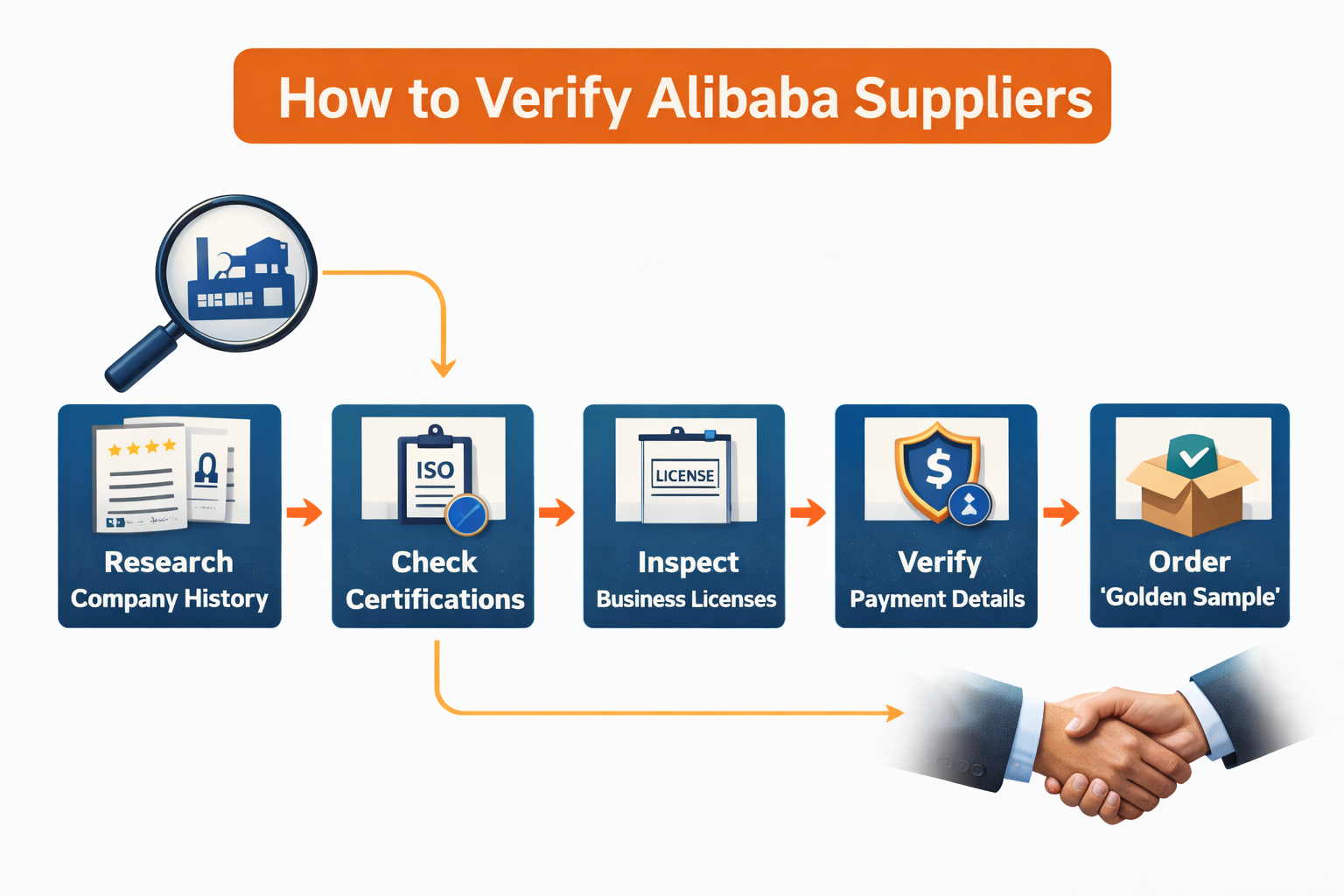
For brands and aggregators, verifying Alibaba suppliers is not optional. It is a structured B2B sourcing process designed to prevent margin loss, quality fade, and operational risk.
Here’s how to verify Alibaba suppliers properly in 2026.
Step 1: Look Beyond the “Verified Supplier” Badge
Alibaba verification badges are useful, but they are not guarantees.
What “Verified” Actually Means
A “Verified Supplier” has passed a third-party audit of documentation and a basic site visit. It does not confirm:
- Consistent quality control standards
- Export experience in your target market
- On-time delivery history
- Production capacity alignment
Verification badges are filters, not final approval.
Filter by Platform Longevity
When verifying Alibaba suppliers, check:
- Years on platform (3+ minimum recommended)
- Transaction level (diamonds or transaction volume)
- Export history to your country
A profile with five stars and no transaction history is a risk. Longevity signals operational stability. Learn more how you can verify suppliers here.
Step 2: Determine If You’re Dealing With a Factory or a Trading Company
Not all suppliers are manufacturers.
Understanding the difference is critical for private label sourcing and wholesale sourcing strategy.
Factory (OEM / ODM Manufacturer)
Best for:
- Lower unit costs
- Custom molds and tooling
- Greater control over materials
Risk:
- Higher MOQs
- Less flexibility across product categories
Trading Company
Best for:
- Lower MOQs
- Bundling multiple SKUs
- Faster communication
Risk:
- Markups
- Less production transparency
- Slower issue resolution
The “General Store” Red Flag
If a supplier sells LED lights, yoga mats, pet bowls, and garden hoses, they are almost certainly a trading company.
Specialists produce better products.
Always align supplier type with your sourcing goals.
Step 3: Audit the Paperwork Properly
Before sending any deposit, request and verify:
Business License
- Confirm legal company name
- Ensure it matches the receiving bank account
- Verify registration number
Mismatched account names are a major scam indicator.
Export License
Not all Alibaba suppliers are legally licensed to export.
Without proper export registration, your shipment may face customs delays or require third-party exporters.
Compliance Certifications
Request certifications relevant to your market:
- CE
- UL
- FDA
- FCC
- CPSIA
Ask for certificate numbers and verify them directly with issuing bodies when possible.
ISO 9001 (Optional but Strong Signal)
ISO 9001 indicates documented quality management systems. It does not guarantee perfection, but it reduces operational chaos.
Supplier verification is about stacking probability in your favor.
Step 4: Apply the “Golden Sample” Rule
Sampling is not optional. It is your last low-cost correction point.
Demand Real-Time Factory Proof
Ask the sales rep to record a 30-second video:
- Inside the production floor
- Showing raw materials
- With today’s date written on paper
This confirms they are physically present and not operating remotely as brokers.
Stress-Test the Sample
Test for:
- Material durability
- Weight consistency
- Structural strength
- Packaging integrity
Quality fade often begins after sample approval.
The approved sample becomes your legal benchmark for production.
Step 5: Structure Payment Terms for Leverage
Payment terms are your only real protection in international trade.
Never pay 100% upfront.
Industry Standard: 30/70
- 30% deposit
- 70% after inspection approval
If a supplier demands full prepayment, walk away.
Always Use Trade Assurance (First Orders)
Keep initial transactions within Alibaba’s Trade Assurance system.
It gives you:
- Escrow protection
- Mediation path
- Dispute resolution
Major Red Flags
Stop immediately if a supplier requests:
- Western Union
- Cryptocurrency
- Personal bank accounts
- “Tax saving” side payments
These are common Alibaba scam patterns.
Step 6: Inspect Before Shipment
Verification does not end when production starts.
Most quality problems appear during mass production.
Pre-Shipment Inspection (PSI)
Hire a third-party inspection company when:
- 80–100% of production is complete
- Goods are packed
Cost: typically $200–$300
Impact: can prevent $20,000+ in losses
Define Acceptable Quality Limits (AQL)
Agree on defect tolerance before production begins.
Without AQL standards, disputes become subjective.
Never Pay Before Inspection
If you release final payment before inspection, you accept the goods “as-is.”
Your leverage disappears.
Step 7: Treat Alibaba Sourcing as a System, Not a Transaction
Most Alibaba losses happen because brands:
- Skip supplier audits
- Rush sampling
- Pay too early
- Avoid inspections
- Fail to calculate landed cost properly
Verifying Alibaba suppliers is not a single action. It is a structured workflow that includes:
- Platform filtering
- Document validation
- Sample approval
- Payment protection
- Quality control
- Logistics clarity
Brand aggregators and scaling DTC brands cannot rely on chat conversations and trust alone.
They need systems.
Stop the Manual Supplier Vetting Spiral
Managing dozens of potential suppliers across Alibaba:
- Tracking samples
- Verifying documents
- Scheduling inspections
- Negotiating MOQs
- Calculating landed cost
Becomes operationally expensive and time consuming.
That’s why structured sourcing platforms exist.
Sourcy centralizes:
- Deep factory verification
- Sample coordination
- Third-party inspections
- Secure payment structuring
- End-to-end logistics oversight
Instead of manually vetting suppliers one by one, brands can build a scalable sourcing system designed for margin protection.
Final Thoughts
Alibaba is not inherently risky. Unstructured sourcing is.
Brands that verify suppliers rigorously, protect payment leverage, and inspect before shipment consistently avoid the most common Alibaba scams.
In 2026, competitive advantage in B2B sourcing comes from process control, not platform choice.
Verify first. Pay second. Inspect always.