What Is a Verified Supplier? How Supplier Verification Works
Sourcing Guide · 4–5 min read

A verified supplier is a business whose identity, credentials, or operating information has been checked through a defined verification process.
However, verification does not automatically guarantee product quality, manufacturing capacity, or reliable delivery.
For brands sourcing products internationally, understanding what supplier verification actually covers helps reduce uncertainty before committing to a manufacturer.
What Does Verified Supplier Mean?
A verified supplier has undergone checks to confirm certain information about its business or operations.
Depending on the platform or verification provider, these checks may cover company registration, business location, manufacturing facilities, certifications, or trading history.
However, not all verification programs assess the same information.
For example, confirming that a company is legally registered does not necessarily prove it can manufacture your specific product at the required quality, quantity, or delivery schedule.
A supplier should therefore be evaluated against your actual manufacturing requirements, not only its verification status.
What Does Supplier Verification Cover?
Supplier verification can involve several different types of checks.
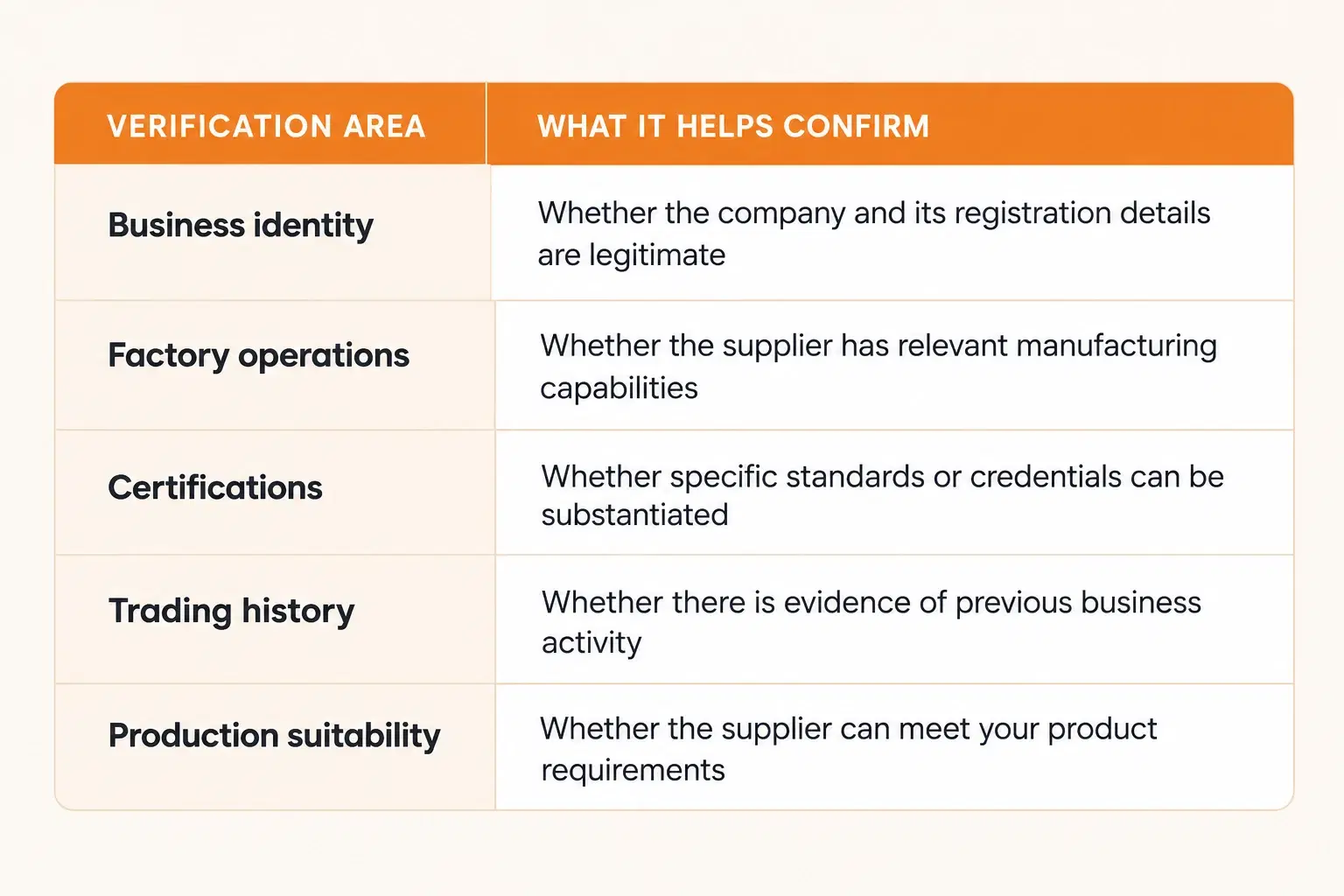
The scope depends on the verification program. Buyers should ask which checks were completed, when they were performed, and what evidence supports the findings.
Why Certifications Matter
Quality management certification may provide useful evidence about a manufacturer's documented processes.
1M+
ISO 9001 certificates · 189 countries
According to the International Organization for Standardization, more than one million ISO 9001 certificates have been issued to organizations across 189 countries.
ISO 9001 establishes requirements for quality management systems, but certification does not guarantee that every product will be defect-free.
For sourcing decisions, certification should support broader supplier evaluation rather than replace it.
Looking for manufacturers that match your product requirements?
Sourcy helps brands identify and compare vetted suppliers based on product specifications, pricing, order quantities, and production needs.
Verified Supplier vs Reliable Supplier: What's the Difference?
Although these terms are often used interchangeably, they describe different aspects of sourcing.
| Verified Supplier | Reliable Supplier |
|---|---|
| Has completed specified checks | Demonstrates consistent performance |
| Focuses on credentials and capabilities | Focuses on quality, delivery, and communication |
| Provides evidence at a point in time | Builds confidence through repeated results |
| Does not guarantee future performance | Must maintain performance over time |
Verification helps establish whether a supplier is credible. Reliability shows whether it can consistently deliver.
For brands planning repeat orders, both factors matter.
What Supplier Verification Cannot Guarantee
Even a verified manufacturer can experience production issues.
Verification alone cannot eliminate:
- Unexpected material shortages.
- Production delays or capacity changes.
- Quality inconsistencies between batches.
- Miscommunication about specifications.
- Unexpected costs associated with customization.
This is why sourcing should include clear requirements, sampling, production follow-ups, and appropriate quality inspections.
How Sourcy Helps Brands Work With Verified Manufacturers
Finding suppliers is only the first stage of successful product sourcing.
Sourcy combines supplier discovery with verification and sourcing coordination to help brands make more informed manufacturing decisions.
Depending on the project, our process includes:
Supplier screening:
Reviewing supplier profiles, business information, and available evidence of manufacturing experience.
Manufacturing assessment:
Comparing product capabilities, MOQ requirements, quotations, and proposed timelines.
Sampling and production coordination:
Helping brands communicate specifications, review samples, and coordinate manufacturing requirements.
Quality considerations:
Supporting appropriate quality checks before products are shipped.
Our approach helps connect supplier verification with the wider sourcing process.
Want to move beyond supplier discovery?
Frequently Asked Questions
What does verified supplier mean?
A verified supplier has undergone checks of specified business or operational information. The exact meaning depends on the verification provider and the checks performed.
Are verified suppliers always reliable?
Not necessarily. Verification can establish credentials or capabilities, but supplier reliability also depends on quality consistency, delivery performance, and communication.
Can a supplier be verified without owning a factory?
Yes, depending on the verification program. A trading company may be a legitimate verified business without owning manufacturing facilities. Buyers should confirm whether they need a factory or a sourcing intermediary.
Does supplier verification guarantee product quality?
No. Product quality depends on specifications, production controls, sampling, testing, and inspections.
Source With More Confidence Through Sourcy
Choosing a manufacturer should involve more than comparing prices or marketplace badges.
By considering supplier credentials, manufacturing capabilities, and production requirements, brands can make more informed sourcing decisions.
Sourcy supports businesses from supplier matching and quotation comparison to sampling, production coordination, and delivery.
Ready to find manufacturers for your next product?