Product Quality Control Checklist: How to Inspect Products Before Shipping
Sourcing Guide · 7–8 min read

A product quality control checklist is a structured list of inspections used to verify that manufactured products meet agreed specifications, quality standards, and packaging requirements before shipping.
It helps brands identify defects, confirm product consistency, and address manufacturing problems before inventory leaves the factory.
Whether you’re launching a new product or placing a repeat order, inspecting finished goods can prevent costly returns, customer complaints, and unexpected delays.
This guide explains what to check during product inspections, how pre-shipment inspections work, and how to handle defects before approving an order.
What Is a Quality Control Checklist in Manufacturing?
A quality control (QC) checklist documents the specific requirements that products must meet during an inspection.
Rather than relying on a general impression that products look acceptable, inspectors use predefined criteria to evaluate product quality consistently.
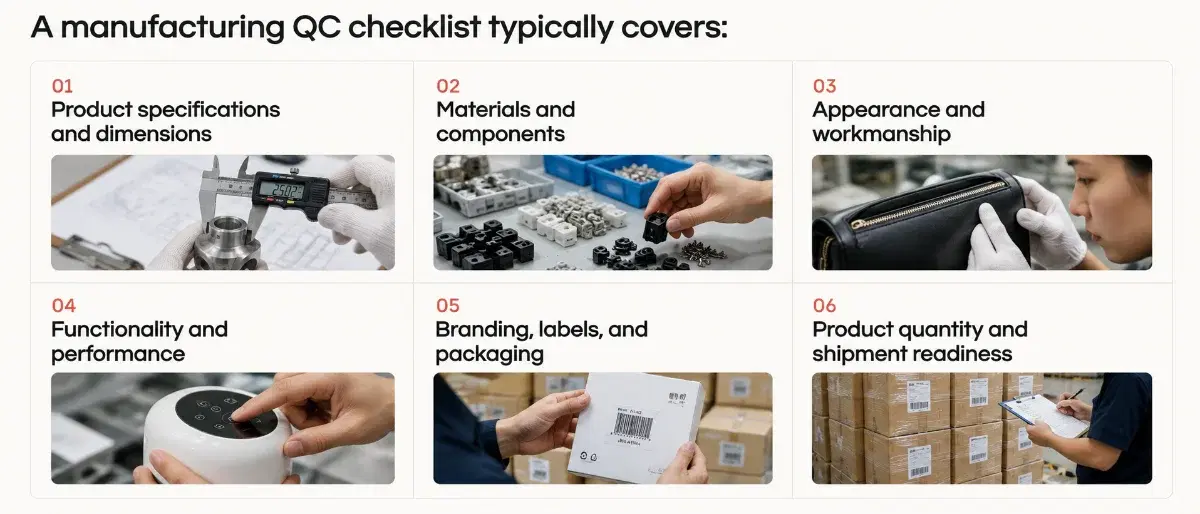
For example, a brand manufacturing customized backpacks might check fabric quality, zipper functionality, stitching strength, logo placement, and packaging accuracy.
Each requirement should be based on approved product specifications, reference samples, and applicable product standards.
Key takeaway: A good QC checklist turns product expectations into measurable inspection criteria.
Why Is Quality Control Important Before Shipping?
Identifying defects before shipping gives manufacturers an opportunity to investigate and correct problems while the goods are still at the factory.
Without proper product inspections, businesses may discover quality issues only after products reach their warehouse or customers.
This can result in
- Additional shipping and replacement costs (see What Is Landed Cost)
- Customer complaints and product returns
- Delayed product launches
- Unsellable inventory
- Damage to brand reputation
The total cost of quality, including prevention, inspection, and failures, can reach 25% or more of sales in some organizations, according to the American Society for Quality.
Clear inspection criteria before shipment help catch defects earlier, before they turn into rework, rejected shipments, or returns.
Quality control cannot eliminate every manufacturing risk, but it creates a consistent process for identifying problems before products are accepted.
Product Quality Control Checklist: 8 Essential Checks
Use the following checklist when reviewing finished products before shipment.
Verify Product Specifications and Dimensions
Confirm that the manufactured products match the approved specifications and reference sample.
Check
- Product length, width, height, and weight
- Color and design consistency
- Materials and components
- Product structure and construction
- Customization requirements
- Approved tolerances
For example, if a bag was approved with a specific strap length and fabric specification, the finished products should match those requirements within the agreed tolerances.
Avoid descriptions such as “approximately correct” unless acceptable variation has been defined.
Inspection tip: Record measurable tolerances for critical dimensions instead of relying on visual judgment.
Inspect Materials and Workmanship
Materials and workmanship affect product durability, appearance, and customer satisfaction.
Check for
- Incorrect or inconsistent materials
- Loose threads or uneven stitching
- Scratches, dents, stains, or discoloration
- Weak seams and connections
- Poorly attached accessories
- Sharp edges or exposed components
- Textile productsFor textile products, pay particular attention to stress points, stitching consistency, and fastening components.
- Plastic productsFor plastic products, inspect molding defects, surface finishing, and component alignment.
The goal is to identify defects that affect product function, durability, appearance, or compliance with the agreed specification.
Test Product Functionality
A product can look correct but still fail during use.
Functional testing checks whether the product performs as intended.
Depending on the product category, this might include:
| Product | Functional quality checks |
|---|---|
| Bags | Zippers, straps, buckles, load-bearing components |
| Drinkware | Lid fit, leakage, closures |
| Apparel | Fasteners, seams, measurements |
| Furniture | Stability, assembly, moving components |
| Electronic products | Power, controls, relevant electrical functions |
Choose tests based on the actual product and its intended use.
Some performance tests may require specialized equipment or laboratory testing rather than a routine visual inspection.
Key takeaway: Appearance checks confirm how a product looks; functional tests assess how it performs.
Check Branding, Labels, and Packaging
Packaging and labeling mistakes can affect customer experience and create compliance problems.
Check
- Correct brand logo and placement
- Product labels and SKU information
- Barcode accuracy and readability
- Packaging dimensions and materials
- Included accessories and instructions
- Shipping carton markings
- Required warning labels and regulatory information
For private-label products, compare the finished packaging against the approved artwork.
A product might be manufactured correctly but still require rework if the wrong barcode, size label, or packaging design is used.
Developing a Customized Product?
Sourcy helps brands coordinate product specifications, sampling, production, and quality requirements so manufacturers have clearer expectations before bulk manufacturing begins.
Verify Product Quantity and Order Accuracy
Confirm that the shipment matches the purchase order.
Check
- Total finished quantity
- Quantity per SKU, size, and color
- Units per carton
- Packaging configuration
- Carton counts
- Any shortages or overproduction
For example, a 1,000-unit order containing four color variations should be checked against the approved quantity for each variation, not simply the overall total.
Quantity verification helps identify discrepancies before shipping arrangements are finalized.
Classify Product Defects
Quality inspectors commonly classify defects as critical, major, or minor, based on their consequences and the agreed inspection criteria.
- CriticalCreates an unacceptable safety or regulatory riskExposed hazardous electrical components
- MajorSignificantly affects function, usability, or saleabilityBroken zipper on a new backpack
- MinorSmall cosmetic issue with limited impact on normal useSlight stitching irregularity within functional limits
Classification should be agreed before inspection and adjusted for the product category, destination market, and customer requirements.
For example, a cosmetic issue that is minor for an industrial component may be unacceptable for a premium fashion product.
Defect classification makes inspection decisions more consistent and reduces disagreements about what constitutes acceptable quality.
Apply an Appropriate AQL Sampling Plan
Inspecting every product is not always practical for large manufacturing orders.
Businesses may use Acceptance Quality Limit (AQL) sampling to inspect a selected sample from a production lot and decide whether to accept or reject that lot.
The international standard ISO 2859-1:2026 defines sampling schemes indexed by AQL for inspection by attributes.
An AQL inspection involves
- Defining the production lot.
- Selecting the appropriate inspection level and sampling plan.
- Randomly selecting units from the lot.
- Inspecting the selected products.
- Classifying detected defects.
- Comparing results against the plan’s acceptance and rejection criteria.
For example, if a production lot contains 1,000 backpacks, an agreed sampling plan determines how many units must be inspected and the applicable acceptance thresholds.
The correct sample size depends on the chosen plan and inspection conditions. It should not be selected arbitrarily.
AQL does not mean every shipment is guaranteed to contain fewer defects than the selected AQL value. It is a statistical lot-acceptance method, not a guarantee of defect-free production.
Safety-critical characteristics may require stricter controls, including appropriate testing or 100% inspection.
Need Help Managing Product Quality?
Sourcy supports sampling, production coordination, and quality checks based on your project’s requirements, helping brands address manufacturing issues before shipment.
Review the Inspection Report Before Shipment
A quality control inspection should produce a documented report.
An effective report includes
- Product and purchase order information
- Inspection date and location
- Lot and sample sizes
- Inspection criteria and AQL plan, where applicable
- Defect counts and classifications
- Measurements and test results
- Photographic evidence
- Overall inspection result
- Required corrective actions
Do not approve shipment based only on a verbal confirmation that the products passed.
Review the report against the agreed acceptance criteria, investigate significant findings, and document the final release decision.
Product QC Checklist: Quick Reference
Use this checklist before authorizing shipment.
Not all checks apply to every product. Add product-specific safety, performance, and compliance requirements where necessary.
When Should You Inspect Products During Manufacturing?
Quality inspections are most effective when they occur at appropriate stages of production, not only after manufacturing is complete.
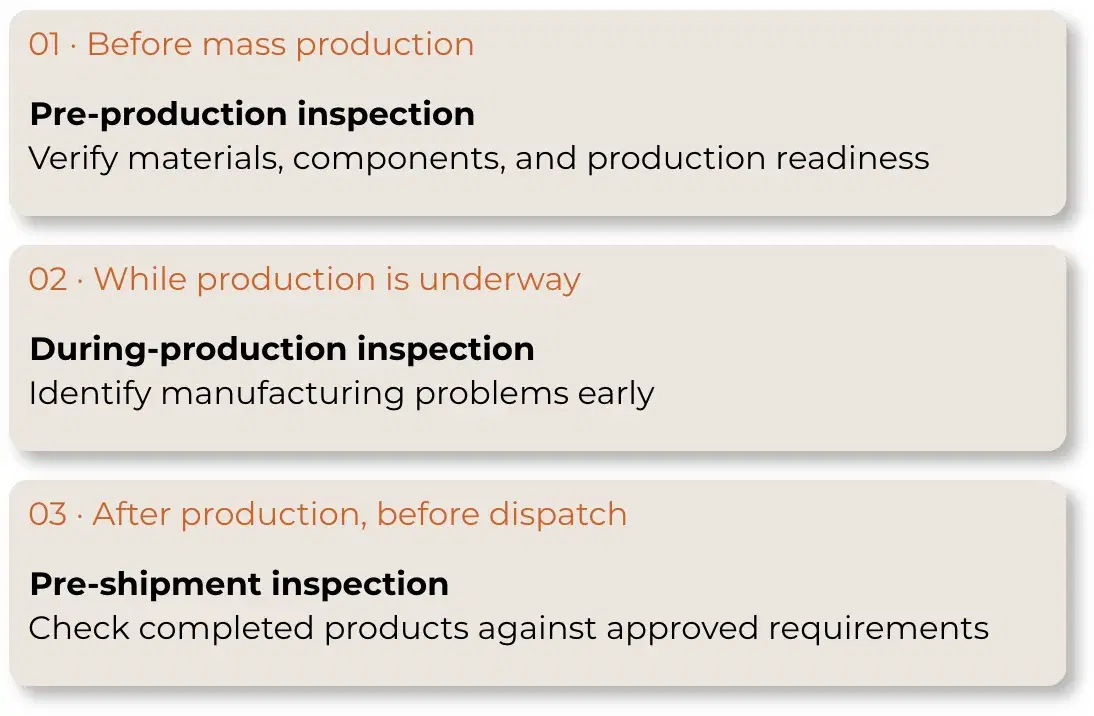
A pre-shipment inspection is particularly useful for identifying defects in completed goods, but it cannot always detect problems hidden within materials or manufacturing processes.
For products with higher quality or safety risks, combine multiple checkpoints with appropriate performance testing.
What Should You Do If Products Fail Quality Inspection?
A failed inspection does not automatically mean the entire order must be discarded.
The appropriate response depends on the nature, severity, and extent of the defects.
Review the Findings
Check which specifications failed and whether the defects are critical, major, or minor.
Confirm the findings with photographs, measurements, and inspection records.
Request Corrective Action
Ask the manufacturer to identify the cause of the problem and propose a corrective action.
Possible solutions include repairing defective products, replacing affected components, remanufacturing products, or sorting the lot.
Confirm Rework and Reinspection
If corrective action is required, agree on who is responsible for the costs and revised timeline.
Reinspect the affected goods, or arrange further testing where appropriate, before approving shipment.
Document the Final Decision
Record whether the shipment was accepted, rejected, or conditionally released under an explicitly agreed exception.
Do not waive critical safety or legal compliance requirements simply to avoid delays.
Inspection Found a Manufacturing Issue?
Sourcy helps coordinate manufacturers, production follow-ups, and quality-related requirements, giving brands a more connected way to manage sourcing through delivery.
How to Create a Quality Control Checklist for Your Product
A useful checklist should be specific to the product rather than copied unchanged across categories.
Start with five practical steps.
Define your quality requirements.
Identify the product characteristics, tolerances, functional tests, and applicable standards.
Use an approved reference sample.
Where appropriate, establish a signed-off physical sample alongside documented specifications.
Identify critical inspection points.
Prioritize characteristics that affect safety, product performance, customer experience, and regulatory compliance.
Agree on defect classifications and acceptance criteria.
Make sure the manufacturer and inspector understand the same requirements before production.
Maintain an inspection record.
Use results to identify recurring issues and improve future orders.
A well-designed checklist should make it clear what to inspect, how to inspect it, and what constitutes a failure.
How Sourcy Supports Quality Control in Product Sourcing
Product quality begins before the final inspection.
Clear specifications, supplier communication, sampling, and production follow-ups all contribute to a more predictable manufacturing process.
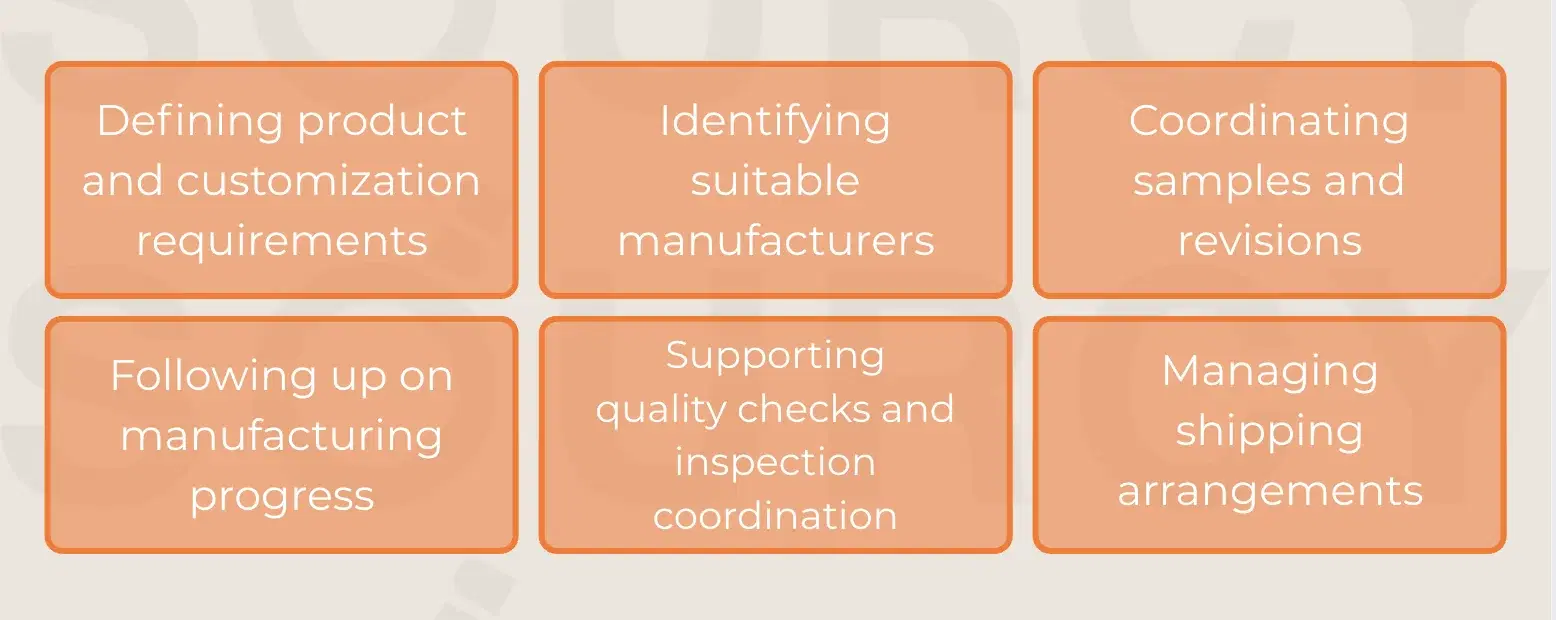
Sourcy helps brands manage these connected stages, including:
If you’re still looking for the right factory, our guide on how to find the manufacturer of a product walks through the search and verification steps.
For brands developing private-label or customized products, coordinating these activities helps reduce the risk of discovering important discrepancies only after production is complete.
The objective is not simply to inspect finished products, but to make quality expectations clear throughout manufacturing.
Frequently Asked Questions About Quality Control Checklists
What is a QC checklist?
A QC checklist is a structured list of quality requirements used to inspect products and verify whether they meet agreed specifications, functionality, appearance, and packaging standards.
What should be included in a product inspection checklist?
Include dimensions, materials, workmanship, functionality, labeling, packaging, quantity checks, defect classifications, applicable testing requirements, and inspection results.
What is AQL in quality control?
AQL stands for Acceptance Quality Limit. It is used in acceptance sampling to define inspection plans and determine whether a production lot meets agreed statistical acceptance criteria.
Is a pre-shipment inspection necessary?
It is a useful risk-control measure, especially for first orders, customized products, high-value shipments, and suppliers with limited performance history. However, it does not replace necessary product testing or manufacturing process controls.
What is the difference between quality assurance and quality control?
Quality assurance focuses on establishing processes that prevent quality problems. Quality control focuses on checking whether products meet specified requirements.
What happens if a product inspection fails?
The manufacturer and buyer should review the defects, agree on corrective actions, verify the results, and determine whether the goods meet the conditions for shipment.
Final Thoughts:
Inspect Before You Ship
A product quality control checklist helps brands turn manufacturing requirements into a consistent inspection process.
By checking specifications, materials, functionality, workmanship, packaging, and defects before shipment, businesses can identify problems earlier and make better decisions about product acceptance.
For growing brands, reliable product quality requires more than a final inspection.
It depends on clear requirements, effective communication, and consistent production oversight.
Ready to Bring Your Product to Market?
From product development and supplier sourcing to production coordination and quality checks, Sourcy helps brands navigate the manufacturing process with greater confidence.