What Is Sourcing in Supply Chain Management?
Sourcing Guide · 9 min read

Sourcing in supply chain management is the process of finding, evaluating, and selecting suppliers that can provide the products, materials, or services a business needs.
For businesses developing physical products, sourcing can involve much more than finding a factory. It can include turning a product idea into clear specifications, identifying manufacturers with the right capabilities, comparing quotations, developing samples, and coordinating production.
Good sourcing isn’t about finding the lowest price.
It’s about finding the right supplier for your product.
QualityCostTimelineCustomization
Why Is Sourcing Important?
Sourcing directly affects product cost, quality, supply risk and whether a product reaches the market on time.
Effective sourcing can help businesses:
Control costs
The right supplier and specification keep unit and total costs predictable.
Maintain quality
A capable supplier holds the same standard from sample to bulk order.
Reduce risk
Vetted and backup suppliers lower your exposure to delays and disruption.
Improve lead times
Matching supplier capacity to your volumes keeps launches on schedule.
Also:Specialized manufacturingCustom product developmentBackup supplier options
These considerations have become increasingly important as global supply chains face tariffs, changing trade conditions, and supplier risks.
McKinsey’s 2025 supply chain survey found that 82% of surveyed companies said their supply chains were affected by new tariffs, while 39% of affected respondents were pursuing dual-sourcing strategies.
Price, therefore, is only one part of a sourcing decision.
Businesses also need to consider MOQ, customization, production capacity, quality, communication, lead time, shipping, and supplier reliability.
Types of Sourcing
Businesses can use different sourcing models depending on their product, market, risk tolerance and supply chain requirements.
Domestic vs Global Sourcing
Domestic Sourcing
Domestic sourcing means working with suppliers in the same country as the business.
It may provide:
- Easier communication
- Shorter transportation routes
- Faster supplier visits
- Simpler logistics
Key consideration: Fewer manufacturing options and potentially higher production costs.
Global Sourcing
Global sourcing means working with suppliers in other countries.
It may provide:
- More manufacturing options
- Specialized capabilities
- Access to different materials and technologies
- Competitive production costs
Key consideration: Shipping, tariffs, quality control, language, regulations, and time zones.
Single vs Multiple Sourcing
Single Sourcing
Single sourcing means relying primarily on one supplier for a product or component.
It may provide:
- Simpler communication
- Easier supplier management
- More consistent production
- Stronger supplier relationships
Key consideration: Greater dependency on one supplier.
Multiple Sourcing
Multiple sourcing means working with several suppliers for a product or across different components.
It may provide:
- Greater supply flexibility
- Reduced dependency on one supplier
- Access to specialized capabilities
- More options for different components
For example: One supplier may manufacture the main product, while another produces custom packaging.
Businesses may also maintain alternative suppliers to reduce supply risk.
According to Deloitte’s 2025 Global CPO Survey, 74% of surveyed procurement leaders identified maintaining active alternative sources as one of the most effective strategies for mitigating risk.
Sourcing vs Procurement: What Is the Difference?
Sourcing focuses on finding and selecting the right suppliers, while procurement manages how the business purchases from them.
In simple terms
Find the right supplier.
Manage how the business buys from them.
| Area | Sourcing | Procurement |
|---|---|---|
| Main focus | Finding and selecting suppliers | Managing the purchasing process |
| Supplier selection | Evaluates potential suppliers | Works with selected suppliers |
| Quotations | Requests and compares quotes | Uses negotiated pricing |
| Purchase orders | Not usually the main focus | Manages purchase orders |
| Payments | Not usually the main focus | Manages payments |
| Supplier management | Evaluates supplier capability | Manages ongoing supplier relationships |
Both are important because choosing the wrong supplier can create problems long after the initial quotation has been accepted.
Finding a supplier is only the first step.
Sourcy helps you compare suppliers, quotations, capabilities and production requirements in one sourcing process.
What Is the Sourcing Process?
A typical sourcing process moves from defining requirements to evaluating suppliers, developing samples, selecting the right supplier and coordinating production.
Define the Product Requirements
Before contacting suppliers, determine what the business actually needs.
This can include:
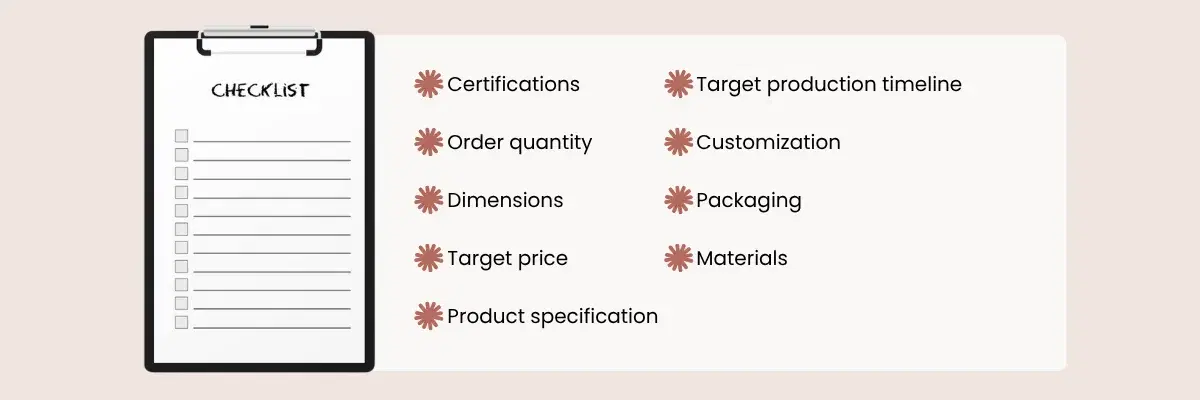
The clearer the sourcing brief, the easier it is for suppliers to provide accurate quotations.
Find Potential Suppliers
The next step is to identify manufacturers with the capabilities required to produce the product.
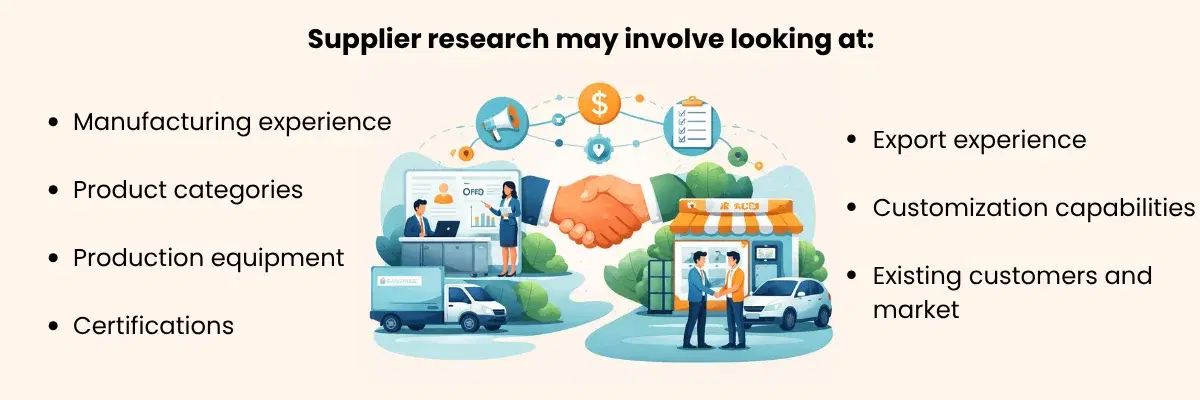
Goal: Find manufacturers with the right capabilities for the product.
Request and Compare Quotes
Once suitable suppliers have been identified, businesses can request quotations. Quotations should be compared across more than unit price.
A sourcing comparison may include:
| Factor | What to Compare |
|---|---|
| Price | Unit price and tooling costs |
| MOQ | Minimum order requirements |
| Materials | Material specifications and grades |
| Customization | Logo, color, size and structural changes |
| Packaging | Standard or custom packaging |
| Lead time | Sampling and bulk production timeline |
| Payment | Deposit and payment terms |
| Shipping | Incoterms and logistics requirements |
This provides a more complete picture of the actual sourcing offer.
Evaluate Suppliers
A low quotation does not necessarily mean a supplier is the best fit for the project.
Businesses should also evaluate:
- Manufacturing experience
- Production capacity
- Quality systems
- Certifications
- Communication
- Responsiveness
- Flexibility
- Lead times
- Previous production experience
This is particularly important for custom products where manufacturing capability can vary significantly between suppliers.
Develop Samples
Samples help verify whether a manufacturer can deliver the required product before mass production.
What to evaluate during sampling:
- Materials
- Dimensions
- Functionality
- Color
- Finishing
- Branding
- Packaging
- Overall quality
Custom products may require several sample revisions before they are ready for production.
Select the Supplier
After comparing quotations, capabilities, samples, and terms, the business can select the supplier or suppliers that best fit the project.
The cheapest supplier is not always the best fit for the project. A supplier with a slightly higher unit price may provide better quality, lower MOQ, stronger communication or more reliable production.
Coordinate Production
Sourcing does not necessarily end after the supplier is selected.
Production may still require:
- Production followups
- Quality inspections
- Packaging confirmation
- Shipment coordination
- Timeline tracking
- Issue resolution
This is especially important when several suppliers are involved in the same product.
- Clearer brief→ More accurate quotation
- Compare more than priceMOQ · Materials · Lead time · Quality · Shipping
- Best fit > Lowest priceQuality · Communication · Reliability
From product requirements to production, sourcing has a lot of moving parts.
Sourcy helps you manage the process — from finding and comparing suppliers to sampling, selection, and production coordination.
What Is Strategic Sourcing?
Strategic sourcing takes a longer-term approach to supplier selection.
Instead of focusing only on the immediate purchase price, businesses consider how a supplier can support their product and supply chain over time.
Factors can include:
- Product quality
- Supplier performance
- Production capacity
- Supply risk
- Flexibility
- Lead time
- Cost stability
- Future order volumes
- Long term business requirements
This approach has become increasingly important as companies try to build more resilient supply chains.
For example, Deloitte’s 2025 survey found that supply chain visibility and supplier collaboration were among the most commonly cited effective approaches to procurement risk management.
Lowest price ≠ Lowest total cost
A supplier with a higher unit price can still provide greater overall value if it reduces quality issues, delays or supply risk.
QualityReliabilityFlexibilityRisk
Common Sourcing Challenges
Common sourcing challenges include unclear specifications, high MOQs, inconsistent quality, communication issues, production delays, hidden costs and coordinating multiple suppliers.
Unclear Product Specifications
Suppliers cannot quote accurately if product requirements are incomplete. Small differences in material, construction, packaging, or finishing can significantly affect price.
High MOQs
Some manufacturers require large minimum order quantities because of production setup costs, material purchases, or customization requirements. For smaller brands, finding suppliers willing to support lower initial quantities can therefore be important.
Inconsistent Quality
A good sample does not automatically guarantee consistent mass production. Quality standards need to be clearly defined and monitored throughout production.
Supplier Communication Issues
Slow responses, unclear quotations, and misunderstandings about specifications can delay product development.
Production Delays
Material shortages, production scheduling, holidays, quality issues, and capacity constraints can affect delivery timelines.
Hidden Costs
The factory unit price is not the final product cost. Businesses may also need to account for:
Looking at the total cost gives a more accurate picture than comparing unit prices alone.
Managing Multiple Suppliers
Custom products may require several manufacturers to work together. One supplier might produce the main product, another the packaging, and another a specialized component.
Managing these suppliers requires coordination across specifications, timelines, quality, and delivery.
Sourcing gets complicated when the details start adding up.
MOQ, supplier communication, samples, quality checks and timelines can quickly become difficult to manage across multiple suppliers.
A Simple Custom Sourcing Example
A single product can require several suppliers to coordinate components, packaging, quality and production timelines.
A product can look simple.
The supply chain behind it may not be.
Imagine a brand wants to launch a stainless steel tumbler with a proprietary lid, custom finish, and branded packaging.
The product may require several suppliers:
| Supplier | Component | MOQ | Lead Time |
|---|---|---|---|
| Supplier A | Stainless steel tumbler | 500 | 25 days |
| Supplier B | Custom lid | 1,000 | 35 days |
| Supplier C | Branded packaging | 1,000 | 20 days |
At first glance, finding a tumbler manufacturer may appear simple. But the actual sourcing project requires the brand to coordinate three different components.
For example, the brand needs to make sure:
- The custom lid fits the tumbler correctly
- Colors and finishes match
- Packaging dimensions fit the finished product
- All components are completed on time
- Quality standards remain consistent
The cheapest supplier is not necessarily the right supplier for the project. The business needs to consider whether each manufacturer can meet its specifications, quality requirements, MOQ, timeline, and coordination needs.
Sourcing is more than finding a factory.
It’s about bringing all the pieces together to turn a product idea into something that can actually be produced.
Have a product idea? Let’s find the right way to make it.
From supplier search and quotation comparison to sampling and production, Sourcy helps you manage the sourcing process from idea to production.
Start sourcingFrequently Asked Questions About Sourcing
Quick answers to common questions about sourcing, suppliers, MOQ and production.
How long does sourcing take?
It depends on the complexity of the product.
Standard products with minimal customization may move relatively quickly, while custom products can require additional supplier research, tooling, sample development, and several sample revisions before production begins.
What is MOQ in sourcing?
MOQ stands for Minimum Order Quantity.
It is the minimum number of units a supplier is willing to manufacture or sell for an order.
MOQ can depend on production setup, materials, customization, packaging, and manufacturing processes.
How do you find a supplier for a custom product?
Start by creating clear product specifications.
Then identify manufacturers with the appropriate production capabilities and compare their price, MOQ, lead time, materials, quality, customization capabilities, and experience.
Sampling should normally be completed before mass production.
What should I include in a sourcing request?
A useful sourcing request should include as much information as possible about:
- Product specifications
- Materials
- Dimensions
- Quantity
- Customization
- Packaging
- Target price
- Quality requirements
- Certifications
- Timeline
Providing clear requirements helps suppliers produce more accurate quotations.
How many suppliers should a business work with?
There is no fixed number.
Some products can be manufactured by one supplier, while more complex products may require different suppliers for components, packaging, or specialist manufacturing processes.
Businesses may also maintain alternative suppliers to reduce dependency on a single source.
What is global sourcing?
Global sourcing means finding and working with suppliers outside a company’s home country.
It can provide access to a larger supplier base, specialized manufacturing capabilities, and competitive production costs.
However, businesses also need to consider logistics, tariffs, regulations, quality control, communication, and lead times.